Less synthetic fertilizer
25% mineral-fertilizer substitution with no yield penalty is documented in multi-soil field trials. Stacked with controlled release, biological N-fixation and sensor-guided dosing, 40–50% is the modeled reduction.
AIDEN Digital Labs presents
Seven living strains in a chitosan nanocarrier. One biostimulant. Replace a quarter of your mineral fertilizer with no yield penalty, and grow crops that defend themselves.
Septem Vitae BM7
Less chemistry, more life. Yield gains of 14–42.5% documented across seven crops and three soil orders — with a quarter less mineral fertilizer and soil that gets richer every season.
Request a free sampleThe product
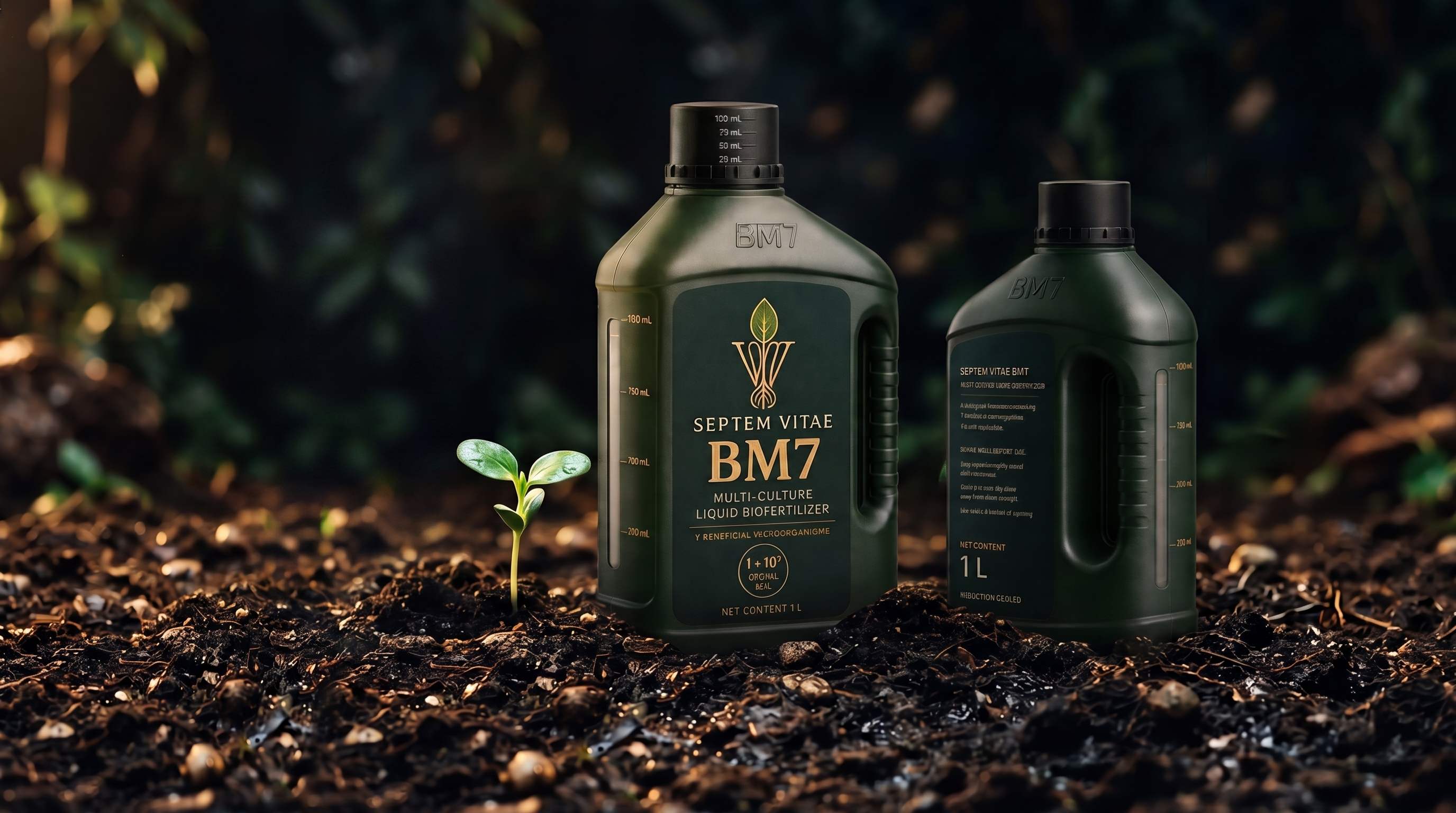
Septem Vitae is a liquid plant-biostimulant concentrate: a defined seven-strain living microbial consortium (BM7), each strain at ≥10⁹ CFU/mL, encapsulated in a 150 nm chitosan nanocarrier that protects the cells and releases them into the root zone over 30–60 days. It is a biostimulant in the AAPFCO-aligned sense — not a fertilizer, not a pesticide, not a growth regulator.
Septem Vitae™ — Latin for seven lives: the trademarked name of the concentrate, and the seven organisms that give it life.
BM7 — Biofertilizer Biogenic, 7-strain. The consortium’s R&D code and the reference of its published prior-art disclosure (Serroune, 2024).
Palmae — The oil-palm-optimised variant, with higher P, K, Si, B and Mo for estates in Indonesia and Malaysia.
25% mineral-fertilizer substitution with no yield penalty is documented in multi-soil field trials. Stacked with controlled release, biological N-fixation and sensor-guided dosing, 40–50% is the modeled reduction.
Induced systemic resistance, silicon-fortified cell walls and a colonised root zone raise crop resilience. 35–45% pesticide reduction is our modeled multi-year estimate — not a label claim. BM7 is not a pesticide.
Root mass +28% at production scale in paddy and +45% in upland rice. Bigger roots capture more water and nutrients and buffer the plant against drought, heat and salinity.
Soil organic matter rises 0.5–0.8% per year, beneficial microbial populations grow up to 2.5× control, and nitrate leaching falls 52%. A living consortium compounds; a chemical wears off.
The seven strains
The science
Tropical acidic soils lose 60–70% of applied fertilizer to leaching. BM7 was built to solve that: keep the nutrients in the root zone, keep the microbes alive long enough to work, and give the plant what it needs to defend itself.
Free microbial inoculants fail in the field because the cells die — from UV, desiccation, heat and predation — before they can colonise. BM7 wraps each strain in a 150 nm chitosan–TPP nanocarrier that shields it and releases it over 30–60 days.
The seven strains establish in the rhizosphere, the few millimetres of soil around each root where nutrient exchange happens. Beneficial bacterial counts rose up to +916% in the Vientiane karst trial.
Organic acids and enzymes free phosphorus, potassium and micronutrients bound in the soil; three nitrogen-fixing strains pull N from the air. Available N +45%, P +38%, K +38% in published trials.
Silicon (150 ppm) hardens cell walls and detoxifies aluminium in acidic soils; Bacillus subtilis switches on the plant’s own systemic resistance. Under drought, heat and salinity, plants kept 75–82% of their photosynthetic efficiency.
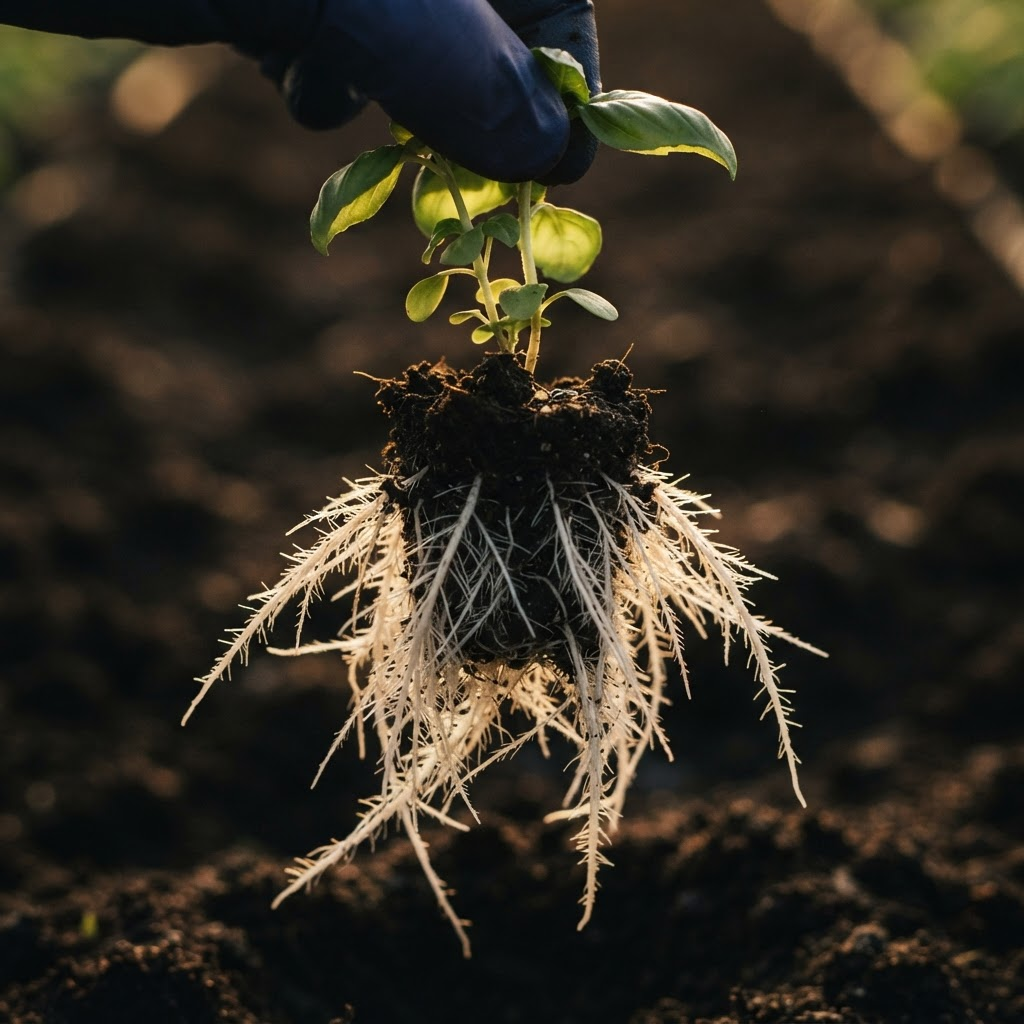
Root mass is the first thing growers notice.
No synthetic pesticide in the formulation. The chitosan carrier is biodegradable, the microbes are naturally occurring, and the product is classified non-hazardous. We publish our composition as prior art so no one can patent it away from farmers.

Field evidence
We state only documented, attributed results — and we label what is modeled or targeted. The evidence base spans a peer-reviewed karst agroforestry study in Laos, an integrated multi-soil-order programme across Kansas Mollisol, Alfisol and Entisol, and a production-scale paddy trial.
We replaced 25% of our mineral N with Septem Vitae on a 50-hectare demonstration block. Yield held. Nitrogen-use efficiency rose. The agronomist was on the farm every month.
The Vientiane karst trial was the reason we started. We saw the paper, we saw the data, we visited the site. The +42.5% cassava yield is not a marketing number — it’s a peer-reviewed number.
Sources: Serroune, S. A. & Inthasak, S. (2024). Impact of nano-enabled multi-strain biofertilizer on crop productivity and soil health in karst agroforestry systems of Vang Vieng, Laos PDR. International Journal of Science and Research Archive, 13(02), 4026–4083, DOI 10.30574/ijsra.2024.13.2.2651. Serroune & Kessler (2026), integrated multi-soil-order validation, internal research report. Results vary with crop, soil, climate and protocol adherence; we do not guarantee a specific yield.
Who we are
“Replace bulk chemistry with engineered biology — profitable for the farmer, restorative for the soil, verifiable by science.”
— Our mission
AIDEN Digital Labs is an agricultural biotechnology, edge-AI and nano-fertilization platform company, founded in 2019 by Shad A. M. Serroune. Our R&D began in the United States; our market vehicles were incorporated in Indonesia in 2024 and Malaysia in 2025 to anchor production and distribution where the need is greatest — the tropical acidic soils of Southeast Asia, where 60–70% of applied fertilizer is lost to leaching.
Septem Vitae is our first product. Alongside it we build INFRANOVA, a root-zone biosensor network that turns biostimulant efficacy into pre-registered, falsifiable predictions — so that a farmer, an agronomist or a regulator can see a defensible number, with its uncertainty, for every claim we make.
Our first commercial season begins with a numbered 100-litre Founders Batch: 20 demonstration plots, 5 university trials, and 300 Founder Kits for early adopters. Pre-registration for samples is open now.
Cost–benefit ratios of 1:2.5 to 1:3.2 in published trials. If the biology does not pay for itself in the field, it is not finished.
Organic matter up, pH corrected, leaching halved, microbial life multiplied. We measure the soil, not just the harvest.
Documented, modeled and targeted figures are always labelled as such. Our INFRANOVA root-zone sensing platform exists to make every claim falsifiable.
The group
Research partners include UGM, IPB, Unhas, Brawijaya and BRIN in Indonesia, and the LACP cooperation in Laos.
Sample conditions
Every sample of Septem Vitae BM7 is provided at no charge. The concentrate ships at ambient temperature with no cold chain, so freight is simple — but customs clearance is outside our control, and delivery conditions depend on where you are.
Domestic delivery. No shipping cost, no customs clearance.
The sample is free. You cover international shipping plus customs clearance and any import duties in your country.
The sample is free. You cover international shipping plus customs clearance and any import duties in your country.
Requests outside the USA and Asia are reviewed case by case. If approved, shipping and customs clearance are at your charge.
The rules in plain words
Pre-registration
Tell us where you grow and what you grow. We confirm each request by email, share the shipping conditions for your region, and dispatch samples in order of registration.